














































FractionalOwnershipAruba.com · Practical guide
Build a due-diligence file before evaluating a fractional proposal

An attractive proposal becomes easier to evaluate when every important statement has a document behind it. A due-diligence file is not a pile of brochures. It is an organized record showing who is involved, what interest is proposed, what evidence has been reviewed and which questions remain open. This is a research method, not a certification that an opportunity exists or is suitable.
Create an index before collecting documents
Use a simple index with document name, date, issuer, version, source and reviewer. Add columns for what the document establishes and what it does not establish. A company extract, a property record, a management contract and an insurance schedule answer different questions. Their presence in one folder does not make them interchangeable.
Keep the seller’s materials separate from independently obtained evidence. Retain originals securely and make annotated working copies. Avoid emailing identity documents to unverified recipients merely to obtain general information. Ask your adviser which personal information is necessary, why it is needed and how to send it safely.
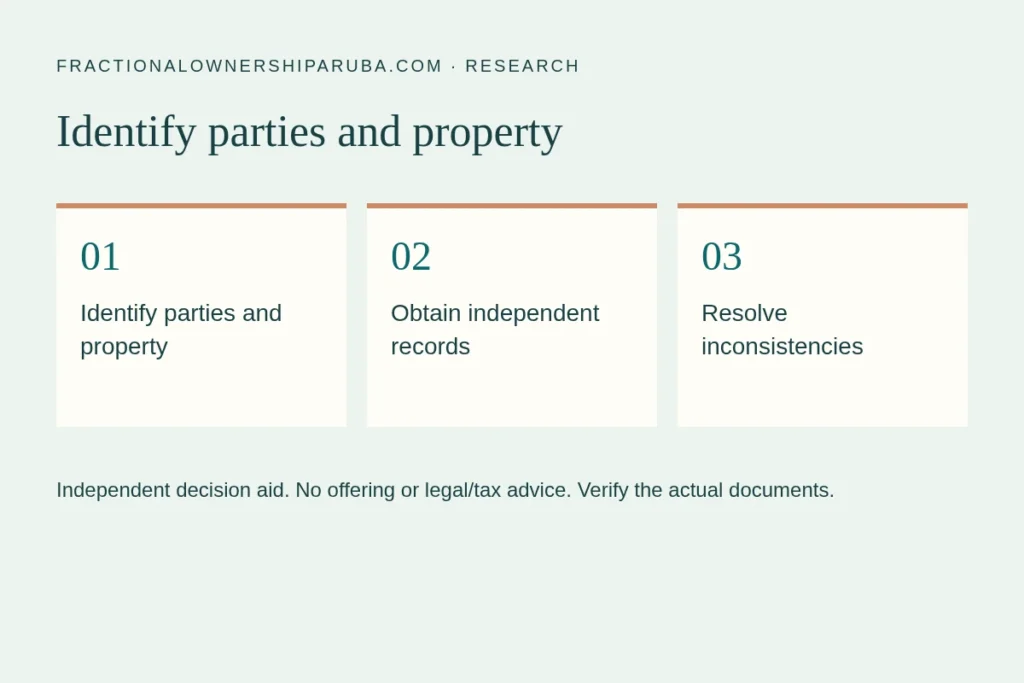
Match the parties across the file
Record the exact legal names and identifiers of the seller, buyer, property-holding entity and manager where applicable. Ask who is authorized to sign and receive funds. A trading name or logo is not sufficient evidence of that authority. If different entities appear in different documents, request a written explanation of their relationship.
The Aruba Chamber is a primary starting point for business-registry research. An extract can support specific identity questions, but it should not be treated as proof of property ownership, a clean financial history or regulatory approval of an investment. Ask the registry or your adviser what an available record actually covers and how current it is.
Connect the proposed interest to the property
Ask an independent local professional what property and land records are appropriate for the transaction. Request the relevant identifiers, title or tenure evidence, restrictions and encumbrance review. Do not infer land rights from photographs or an address on a marketing page. If the proposed interest sits inside an entity, ask how that entity’s interest in the property is established.
Use DIP as a route for land-administration research and the notarial source below for first-party context on property-law questions. Neither link verifies a particular asset. Avoid assuming that a general description of ownership or land tenure determines the treatment of the specific documents in front of you.
Read operational documents together
Collect the governing agreement, booking rules, budget, reserve policy, management agreement, insurance information and transfer provisions where applicable. Ask how inconsistencies are resolved and which document takes precedence. Check whether appendices are included, whether policies can change and whether the version supplied is the version you would sign.
Request explanations of significant missing records. If a project is proposed rather than operating, separate projections and draft rules from completed approvals and executed contracts. Ask who bears the risk if a promised service, unit or legal step is not delivered. Do not quietly convert a future intention into an existing fact in your notes.
Turn findings into a decision log
For each unresolved issue, write the question, the evidence required, the independent reviewer and the next action. A verbal answer can be a useful lead, but record important conclusions in writing and ask the adviser to identify assumptions. Use our checklist and research resources as an index, not a substitute for professional work. Do not mark the file complete merely because every folder contains something. Completion means the relevant questions have reliable answers, or the remaining uncertainty is explicitly understood.
Primary sources and further checks
- Aruba Chamber of Commerce ↗
- Government of Aruba — land and erfpacht ↗
- Notary Yarzagaray — property-law information ↗
These sources provide official or first-party context, not approval of a fractional product. Confirm current rules and their application with the responsible authority or your independently engaged adviser. A linked provider is not a site partner or endorsement.
Editorial review: 5 November 2026. Educational information only; not an offering, legal opinion, tax advice or return forecast. Verify the actual arrangement independently.