














































FractionalOwnershipAruba.com · Practical guide
Prepare an adviser meeting that produces usable answers

An independent adviser can work more effectively when you bring a defined question and the relevant documents. Asking whether a fractional proposal is safe is too broad to produce a useful answer. Break the decision into rights, costs, control, use and exit, then identify who is qualified to review each issue. This guide is a meeting-preparation tool, not legal, tax or investment advice.
Choose the question before choosing the meeting
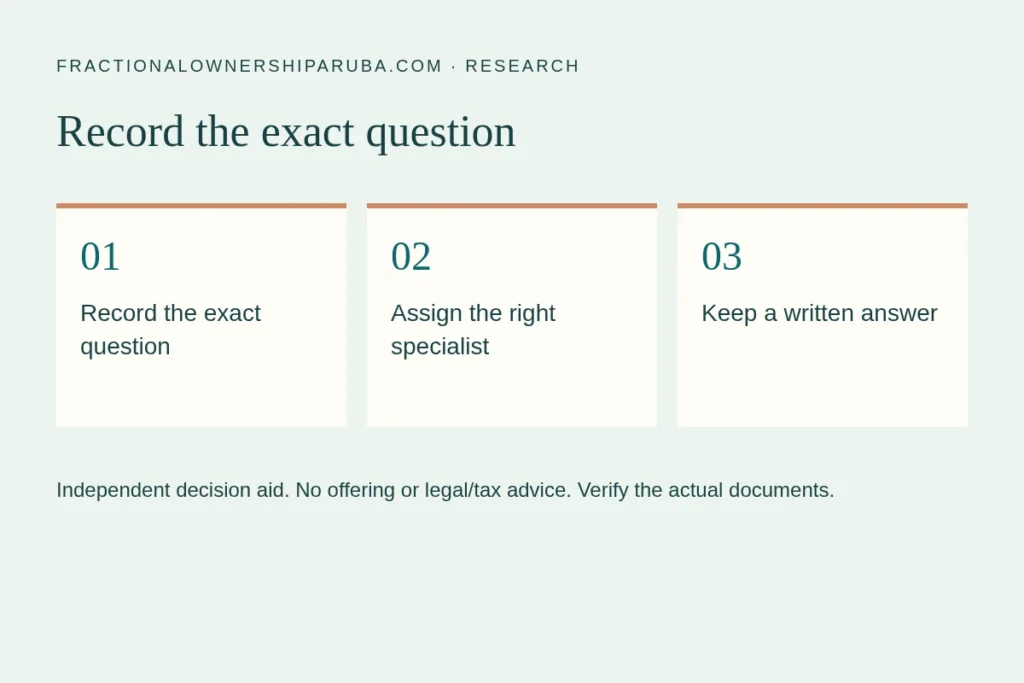
Write a short description of the proposed interest without repeating promotional claims. State what you want to understand and which decision depends on the answer. For example, ask what documents establish the interest and what obligations would survive a period of non-use. These are more concrete questions than whether a brochure looks legitimate.
Ask the professional to confirm their scope, relevant experience, fees and any relationship with the promoter. The role of a notary, a lawyer, a tax adviser and a financial professional may differ. Do not assume that a person involved in completing a transaction is also giving you every kind of independent advice you need.
Bring a compact, traceable file
Provide a document index, the proposed contract and its appendices, identity details for the parties, property identifiers where relevant and the current budget. Label drafts and unsigned documents. Include your own practical constraints, such as preferred use periods, financing assumptions or a potential need to exit early.
Keep a separate list of statements that you have not independently verified. Ask which additional records the adviser wants to obtain directly and why. Avoid overwhelming the meeting with screenshots when a complete dated document is available. Do not conceal an inconsistency because it seems minor; explaining conflicting names or versions may be central to the review.
Allocate specialist questions deliberately
For legal review, ask about the interest, authority, obligations, governance, transfer restrictions and dispute process. For tax review, ask which jurisdictions and personal circumstances matter, which events may create obligations and what records to keep. This website intentionally provides no tax rate or conclusion about how a fractional structure will be treated.
For operational review, ask who controls reservations, budgets, repairs and service continuity. If regulated financial activity is claimed, ask the relevant authority how to check that specific claim. A regulator’s existence is not evidence that a property product falls within its remit. Likewise, a business registration is not a promise of investment protection.
Ask for an answer you can use
At the end of each topic, distinguish established facts, assumptions, unanswered questions and the next step. Ask whether the adviser’s conclusion depends on a missing document or a later event. Request a written explanation where appropriate and agree how you should handle subsequent changes in the proposal.
Do not ask the adviser to confirm a conclusion that you have already decided to accept. A useful review can identify reasons not to proceed, a need to renegotiate or an issue outside the professional’s scope. Ask how to verify the professional’s own credentials through the appropriate independent channel before sharing sensitive documents or making payment.
Close with a decision and follow-up list
Use the question worksheet and due-diligence checklist to record who owns each follow-up. Ask what must be resolved before signing, before paying and before completion. Keep all answers tied to the actual version reviewed. Professional advice is most useful when its scope and limits are clear; neither a meeting nor a source link replaces the evidence needed for your particular decision.
Primary sources and further checks
These sources provide official or first-party context, not approval of a fractional product. Confirm current rules and their application with the responsible authority or your independently engaged adviser. A linked provider is not a site partner or endorsement.
Editorial review: 5 November 2026. Educational information only; not an offering, legal opinion, tax advice or return forecast. Verify the actual arrangement independently.